Early Years and 21st Century Skills at The Shri Ram Universal School, Sarabha Nagar
The short answer: At age 3 to 5, 21st century skills are not about screens or coding. They are curiosity, talking and listening, working with others, solving small problems, early STEM play and the confidence to speak up. In the Early Years at The Shri Ram Universal School, Sarabha Nagar, Ludhiana, children build them every morning through Circle Time, Wonder Time, stories, role-play and hands-on play, and you can build them at home with a few simple habits.
Parents often ask us what "21st century skills" can possibly mean for a three-year-old who is still learning to hold a crayon. It is a fair question. So in this post we want to show you what it looks like in a real Nursery or KG room, and what you can do at home.
What 21st century skills really mean at age 3 to 5
Older students at our school go on to build robots and learn coding in our labs. Nobody is doing that in Nursery, and nobody should be. At this age, the skills that matter later start as very small, everyday things:
- Curiosity: asking "why?" and wanting to find out.
- Talking and listening: saying what you think, and hearing what someone else says.
- Working with others: sharing, taking turns, playing a game together.
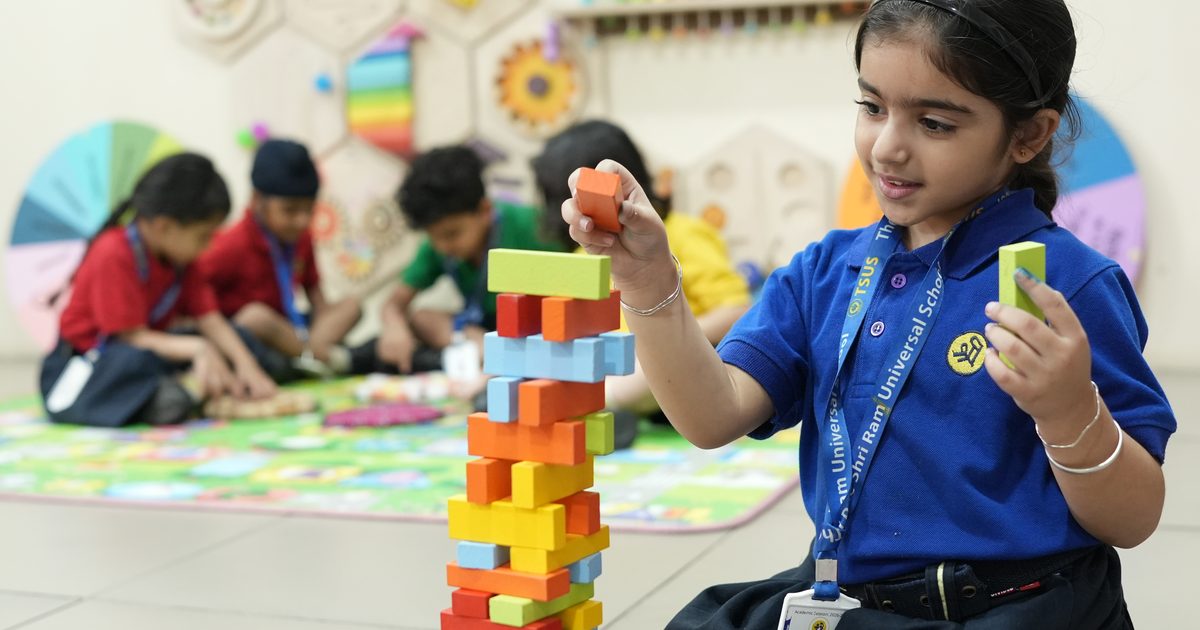
- Problem solving: trying again when the tower falls down.
- Early STEM play: counting, sorting, pouring, testing what floats.
- Confidence: standing up in front of the group, even in a whisper.
This is what we mean by a holistic start. We look at how a child feels, speaks, plays and gets along, not just at what she knows.
Where you will see these skills in our Early Years
Curiosity: Wonder Time
Every day in our Early Years has Wonder Time, set aside for the questions children ask. And three-year-olds ask plenty. What happens when you push a glove full of air under water? Why does the paper boat float?
Talking and listening: Circle Time and stories
The day begins with Circle Time. Children sit together, greet each other, sing a rhyme and talk about the theme of the week. For a shy child, saying good morning to the whole circle is a real step, and teachers notice when it happens. The morning ends with a story, and DEAR time (Drop Everything And Read) gives every child fifteen minutes with books, so even our youngest see that reading is something everyone does.
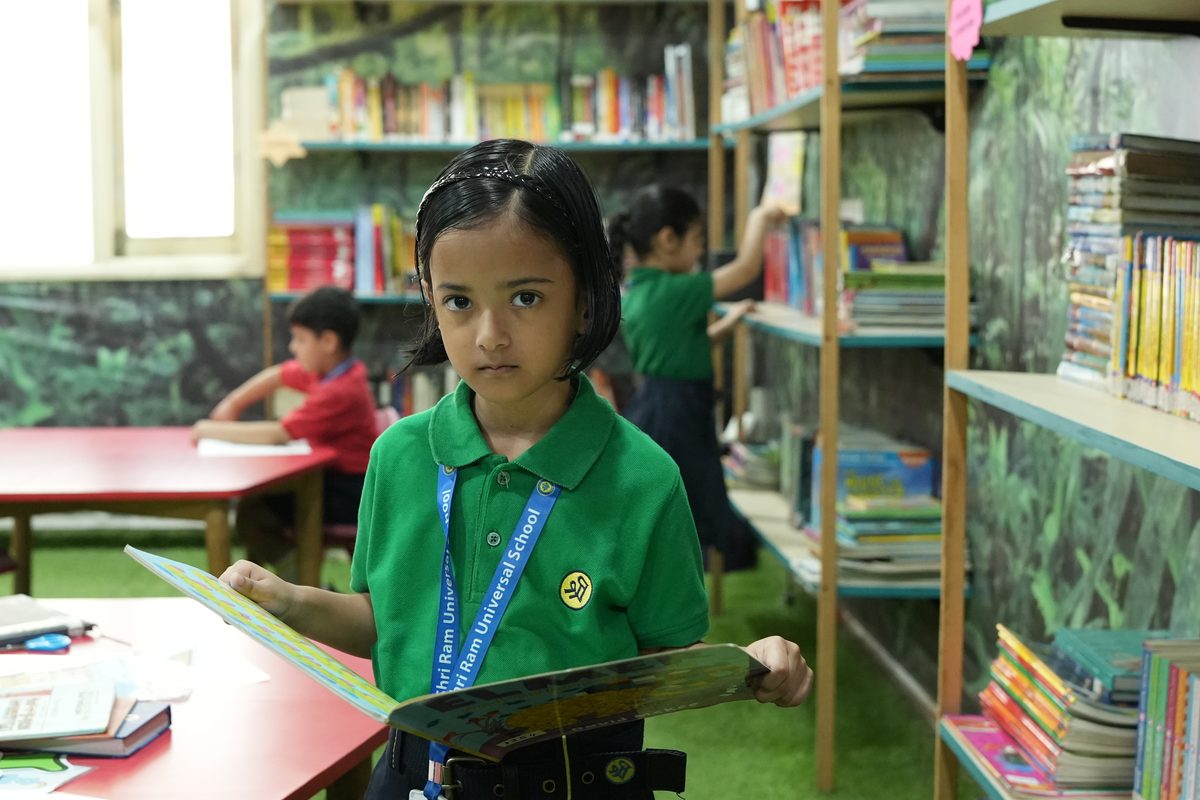
Books and stories are part of every day.
Working with others: role-play and floor games
In our role-play room, one child runs the toy kitchen while others queue up to order. Taking turns is half the game. Floor games work the same way: children learn to wait, to count their moves and to play by the same rules.
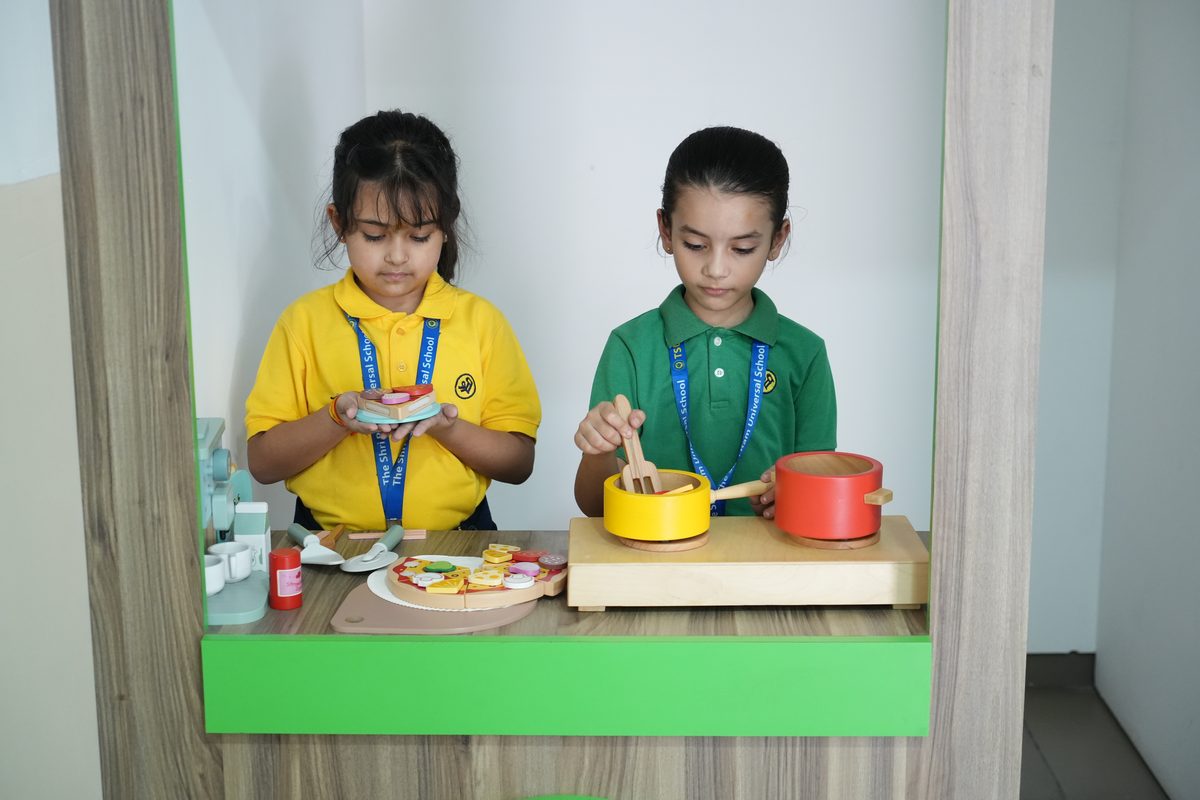
Cooking up a meal together in the role-play kitchen.
Problem solving: puzzles, blocks and trying again
We watch for small moments. Did he go back to the puzzle after it fell apart? Does she count the blocks or guess? A child who tries again after a mistake is learning one of the most useful skills there is.
Early STEM play: sand, water and counting
STEM at this age is hands-on. Sand and water, sorting coloured balls, counting blocks and listening for letter sounds all build early number and science sense. With Art Integration, children learn shapes and colours with paint and clay in their hands before they ever meet them on a worksheet, and our corridors and walls are designed to teach as well. Our STEM and Digital Literacy labs begin from Grade 1, when children are ready for them.
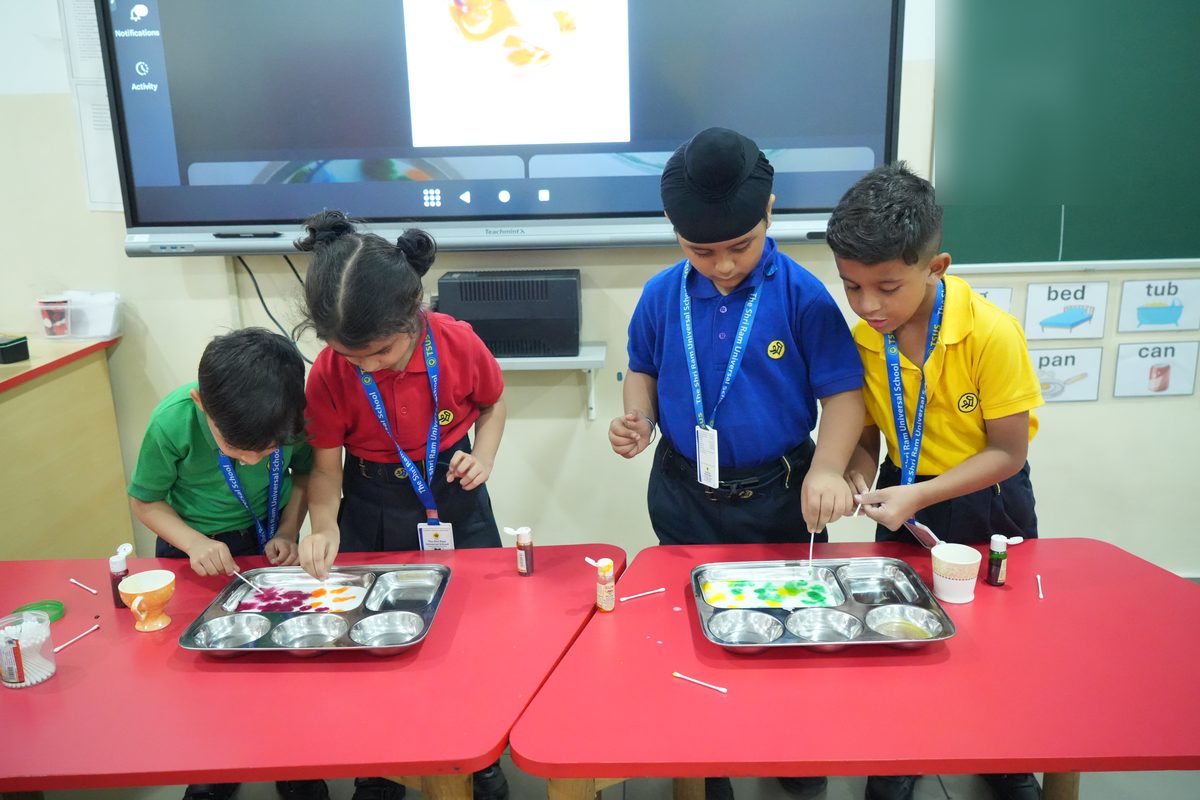
Wonder Time: what happens when the colours meet?
Confidence: Show and Tell
Show and Tell and role-play give every child a regular chance to speak in front of the group. Some days that is a confident little speech. Some days it is a whisper and a toy held up. We count both.
Read more about how a morning runs on our Early Years page.
How we notice progress without exams
There are no formal exams in Pre-Nursery, Nursery, LKG or UKG. Instead, teachers watch how a child understands, applies and tries.
Our classes generally have 20 to 30 children. Our teacher-student ratio across the Early Years wing is 1:10. We count that across the whole wing, so a wing with 100 children has 10 teachers, made up of class teachers and specialist teachers. It does not mean three teachers in every class. What it does mean is that the same adults see the same children every day, and they notice the quiet child as well as the loud one. That is what a nurturing classroom means to us: someone always knows how your child's morning went.
Simple ways to build these skills at home
You do not need flashcards or apps.
- Answer a question with a question. When your child asks why the ice melted, ask, "What do you think?" and then test it together.
- Read every day, and stop to talk. Ask, "What will happen next?" or "How is the bear feeling?" It builds listening and language.
- Cook together. Counting spoons, pouring water and sorting vegetables is real maths and science.
- Play simple board games. Snakes and ladders teaches counting, waiting your turn and losing gracefully.
- Let them struggle a little. Wait a few seconds before you fix the shoe or the puzzle. Praise the trying, not just the result.
- Give small jobs. Carrying their own bag or setting out spoons builds confidence and a sense of "I can".
- Ask about their day in detail. "Who did you play with?" works better than "How was school?"
Come to a Saturday storytelling session
The easiest way to see all this is to bring your child to one of our free Saturday Early Years storytelling sessions, at 10:00 am or 11:30 am. It is a relaxed way for your child to meet our teachers, and for you to ask every question you have. Please come in through Gate 1; parking is just outside. To book a place, call +91 98140 78825 or email admissions@tsusludhiana.com.
Frequently asked questions
What are 21st century skills for young children?
For children aged 3 to 5, they are curiosity, talking and listening, working with others, problem solving, early STEM play and confidence. They grow through play, stories and conversation, not through screens or worksheets.
From what age can my child join the Early Years at The Shri Ram Universal School, Sarabha Nagar?
From the 2027-28 session, Pre-Nursery is for children of about 2 to 2.5 years, and Nursery is for children of 3. Our 2027-28 nursery age guide explains how to work out your child's age.
Is play-based learning real learning?
Yes. The play is planned. Circle Time builds language, Wonder Time builds curiosity, role-play builds teamwork, and hands-on work with sand, water, blocks and art builds early number and science sense. Children are assessed on understanding, application and effort, not exams.
Does my child need to use screens or coding at this age?
No. In our Early Years, STEM is hands-on play. Our STEM and Digital Literacy labs begin from Grade 1.
Are admissions open, and what does it cost to apply?
Admissions for 2027-28 are open. Seats are limited, so we suggest registering early. Registration is a one-time Rs 1,000. Please contact admissions for the fee structure.
Come and see a morning for yourself
The Shri Ram Universal School, Sarabha Nagar is a CBSE school (affiliation no. 1631479) from Nursery to Grade X, with Pre-Nursery starting from 2027-28. We are in Block D, behind Main Market, Sarabha Nagar, Ludhiana 141001. See every step on our admission process page, catch up on school life in our news and updates, or call +91 98140 78825 to book a visit. We would love to meet you and your child.
Ms. Amandeep Kaur
Assistant Coordinator, Elementary Wing, The Shri Ram Universal School, Sarabha Nagar