
Robotics & Coding
Students design, build, and program robots using Arduino, Raspberry Pi, and advanced robotics kits — learning engineering and coding through real construction.
From Robotics and AI to Drones and Space Science — Our Centre of Excellence Prepares Students for the Careers of Tomorrow Through Hands-On, Project-Based Learning
Students design, build, and program robots using Arduino, Raspberry Pi, and advanced robotics kits — learning engineering and coding through real construction.

From artificial intelligence and machine learning to Internet of Things and automation — students work with the same technologies powering today's industries.

Students transform creative ideas into working prototypes using 3D printing, CAD software, and structured design thinking methodologies.
Develop analytical skills through problem-solving challenges and scientific inquiry.
Foster creativity and innovation through hands-on experiments and prototype building.
Work in teams to tackle complex projects and learn from diverse perspectives.
Connect classroom learning to real-world challenges and career opportunities.
Prepare for national and international STEM competitions and olympiads.
Build competencies in emerging technologies like AI, robotics, and biotechnology.
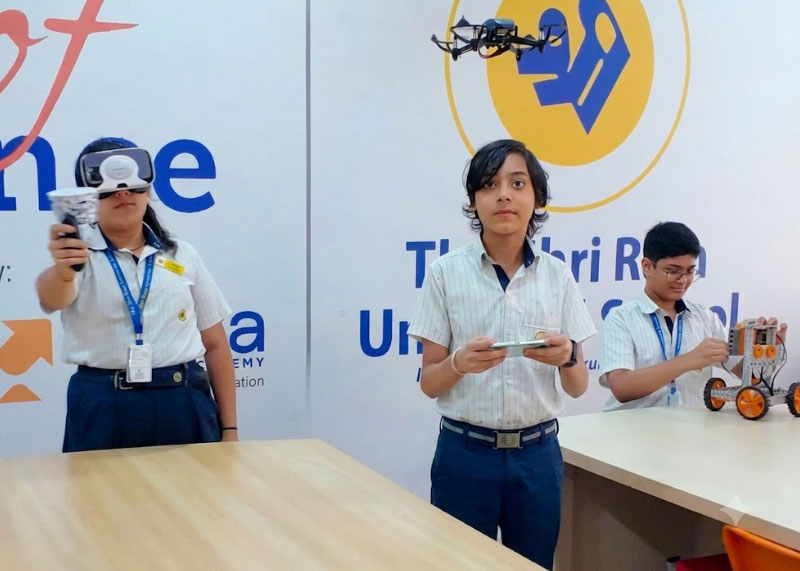
Our Centre of Excellence covers every major domain of modern science and technology — giving students breadth of exposure and depth of understanding.

Build and program robots — from crane systems to soccer-playing bots.

Scratch, block-based, Python, and humanoid robot programming.

Face recognition, warehouse bots, smart door systems, and predictive AI.

Assemble, program, and fly drones for rescue, agriculture, and exploration.

Smart irrigation, home security, line followers, and automated parking.

Radar systems, solar circuits, security systems, and traffic control models.

Build a functional electric vehicle from chassis assembly to road test.

Chandrayaan models, solar system study, rocketry, and telescopes.

3D torso models, microscopes, health bots, and diagnostic tools.

Pattern recognition, logic puzzles, and structured reasoning exercises.
A structured, month-by-month programme combining expert instruction, self-paced practice, project building, and regular assessments.
Guided session by a Myra Academy trainer in the first week of every month.
Students revisit lessons anytime through personalised learning platform credentials.
Hands-on projects to apply concepts and build a growing portfolio of real work.
Fourth-week evaluations to track progress, identify gaps, and celebrate wins.
Quarterly events where students present five or more creative innovations.
Progress reviewed jointly by mentors and school leadership each term.
Bi-annual showcases of outstanding projects for the school community and parents.
Detailed dashboards for students, parents, and school — refreshed every month.
Our STEM Lab mirrors real-world innovation spaces — equipped with the latest technology and designed to foster creativity, collaboration, and critical thinking.

Arduino, Raspberry Pi, and advanced robotics kits for hands-on coding and construction.

Modern equipment for physics experiments, circuit design, and electronics prototyping.

3D printing, CAD software, and prototyping tools for creative problem-solving.

Software tools for data analysis, AI experimentation, coding practice, and maths modelling.
Our partnership with Myra Academy ensures expert mentors, cutting-edge equipment, and a comprehensive curriculum — all on campus.

End-to-end lab setup with equipment, tools, kits, and ongoing project management support.

Personalised LMS for every student and trainer with secure cloud-based data storage.

Unique credentials for both guided lab sessions and self-paced exploration at home.

A qualified Myra Academy STEM mentor stationed full-time on our campus.

Covering robotics, AI, drones, space science, medical tech, EV, IoT, coding, and more.

Detailed reporting for students, parents, and school — refreshed with fresh data every month.
Our STEM Lab curriculum supports NEP 2020's emphasis on scientific temper, computational thinking, and hands-on experiential learning.
Students learn by building, testing, and iterating — not listening to lectures about science.
Projects naturally combine physics, maths, computer science, and design — as NEP envisions.
17 tech domains help students discover aptitudes well before choosing a career stream.
Project portfolios and practical assessments replace memorisation with demonstrated capability.
-